
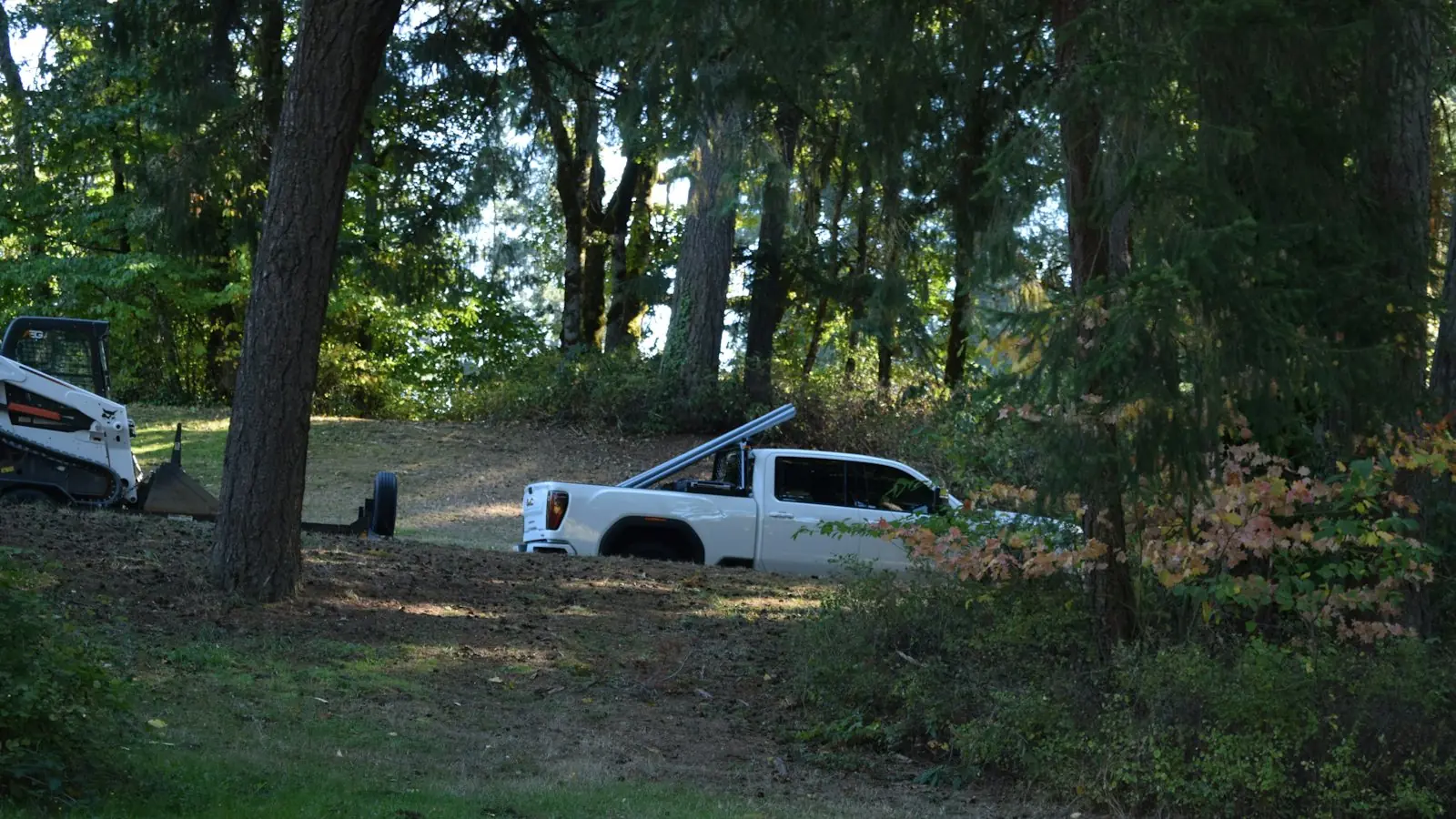
Quick answer: If your business owns, leases or regularly uses a truck, van or trailer for jobs, you need commercial auto insurance; a personal auto policy usually does not cover business driving. The Hartford reports that its commercial auto customers pay about $574 a month, or $6,884 a year, on average across all industries, and a contractor's price follows the number and type of vehicles, drivers, radius and limits. Watch three gaps: tools in the truck are typically not covered by the auto policy, heavy equipment like skid steers is usually not an "auto" at all, and employees driving their own cars need hired and non-owned auto coverage.
This guide covers what contractors pay, which vehicles a business auto policy actually covers, where trailers, equipment and tools fit, when federal and state registration rules apply, and what general contractors ask for before you start work. For a quote, see our contractor commercial auto page.
How much commercial auto insurance costs for contractors
The most direct published figure is The Hartford's: its commercial auto customers pay about $574 a month on average. That is an average across every industry and fleet size, so a one-truck handyman and a 20-vehicle site work contractor both sit inside it. The Hartford lists the factors that move the price: the amount of coverage a specialized vehicle needs, limits and deductibles, the type of business and miles driven, driving records, and the number of vehicles. For a contractor, here is how those show up.
| Driver | Why it moves the price | What to have ready |
|---|---|---|
| Vehicle type and weight | A light pickup, a cargo van, a dump truck and a boom truck are rated very differently | Year, make, model, VIN and gross vehicle weight rating for each vehicle |
| Use and radius | Local service work rates lower than hauling between metro areas or across state lines | Typical job radius and any regular long-distance runs |
| Garaging address | Where vehicles park overnight sets the territory rate | Current garaging address for each vehicle |
| Drivers | Every listed driver's record is checked, and young or inexperienced drivers cost more | Names, license numbers and dates of birth for everyone who drives |
| Limits | Contracts often require higher liability limits than state minimums | The insurance section of your largest contracts |
| Physical damage and deductibles | Collision and comprehensive follow each vehicle's value | Values, loan or lease details, and the deductible you can absorb |
| Claims history | Recent accidents carry into pricing for several years | Three to five years of loss runs |
For many service trades, auto is one of the biggest lines in the program, sometimes rivaling workers' comp. Our contractor insurance guide shows how it fits with general liability, comp and the umbrella.
Do contractors need commercial auto insurance?
If the business owns or leases the vehicle, yes. If you drive a truck titled in your own name but use it mainly for jobs, talk to your broker before assuming your personal policy will respond: The Hartford warns that without business auto coverage, your personal auto policy may exclude coverage and you may be responsible for the claim. The questions that decide it are who owns the vehicle, what it carries, who drives it and how much of its use is business.
Your general liability policy will not fill the gap. Standard GL forms exclude injury and damage arising from autos you own or use, which is why auto is a separate line in every contractor program.
Which vehicles your policy covers: the covered auto symbols
On the standard ISO business auto form, a number next to each coverage on the declarations page decides which vehicles that coverage applies to. These are the ones contractors see most often:
| Symbol | What it covers | Why it matters to a contractor |
|---|---|---|
| 1 | Any auto | The broadest liability option: owned, hired and non-owned autos in one symbol |
| 2 | Owned autos only | Covers every truck you own, including new ones, but not rented or employee vehicles |
| 7 | Specifically described autos | Only the vehicles listed on the schedule. A new truck is picked up only in limited cases, such as a replacement or if you report it within 30 days |
| 8 | Hired autos | Rented or borrowed vehicles, such as a box truck rented for a job. Vehicles hired from your own employees are not included |
| 9 | Non-owned autos | Vehicles you do not own, including employees' cars while used in your business |
Symbol 7 on liability is where gaps hide: the truck you bought last month, or the van you rented for a busy week, may not be covered. Ask your broker which symbols are on your policy and whether symbols 8 and 9 are there for liability. Our hired and non-owned auto guide covers the employee-car exposure in detail.
Trailers, heavy equipment and tools: what the auto policy does not cover
Trailers
List every trailer you own on the auto policy. Under the current multistate edition of the business auto form, non-owned trailers are covered automatically only up to a registered gross vehicle weight rating of 3,000 pounds, and for liability a trailer generally follows the power unit pulling it. A borrowed equipment trailer heavier than that needs a conversation with your broker before you hitch it.
Skid steers, excavators and other mobile equipment
Earth movers, forklifts, tractors and similar machines are "mobile equipment", not autos, even when they are self-propelled, unless a motor vehicle law applies to them. As IRMI explains, liability from mobile equipment is covered by your general liability policy, and physical damage to the machine is usually covered by an equipment floater. A skid steer stolen off a job site is not an auto claim.
Tools and materials in the truck
The Hartford is direct about this: tools and materials inside your vehicle at the time of an accident typically are not covered by your commercial auto policy. A truck break-in that takes a full set of power tools is a property or inland marine claim. Most contractors cover tools with a contractor's equipment or tool floater; see our inland marine guide.
Do you need a USDOT number?
Many contractors do and do not realize it. Under FMCSA's rules, you need a USDOT number if a vehicle used in interstate commerce has a gross vehicle weight rating or gross combination weight rating of 10,001 pounds or more, among other triggers. Gross combination weight counts the truck and trailer together, so a pickup towing an equipment trailer can cross the line even when the pickup alone would not.
Staying inside one state does not always get you out of it. FMCSA lists the states that require their intrastate commercial vehicle registrants to get a USDOT number, and of the 16 states where Aiden Risk is licensed, every one except Illinois and Virginia is on that list. State thresholds and rules vary, so check with your state agency. Underwriters will ask for your USDOT number if you have one, and a mismatch between your registration and your policy is worth fixing before a claim.
State minimums versus what your contracts require
Every state sets a minimum amount of auto liability, and the minimums are low. In Texas, for example, the minimum is $30,000 per person and $60,000 per accident for bodily injury, plus $25,000 for property damage. A single serious crash with a work truck can run far past that.
General contractors, property owners and public agencies usually ask for much more. Commonly requested terms include:
- A liability limit of $1 million per accident, and an umbrella above it on larger jobs.
- Additional insured status on your auto policy, not just your general liability. See our additional insured guide.
- A waiver of subrogation in favor of the GC or owner, endorsed on the auto policy. See our waiver of subrogation guide.
- Coverage for any auto, or owned, hired and non-owned autos, rather than scheduled vehicles only.
- An umbrella that sits over auto. Confirm it follows form over your auto policy; our umbrella guide explains what to check.
Check the requirements before you bid, not when the GC rejects your certificate. Our COI checker helps contractors compare what a contract asks for against the coverage they describe.
How contractors can lower commercial auto cost
- Keep the driver list current. Remove people who no longer drive for you, and review motor vehicle records before adding new hires.
- Fix vehicle classes and garaging. A light pickup rated as a heavier truck, or an old garaging address, can cost more than it should.
- Match physical damage to vehicle value. Older trucks may not need full collision coverage, and a higher deductible lowers premium if you can absorb it.
- Put tools and equipment on the right policy. Covering them under inland marine keeps auto claims cleaner and coverage clearer.
- Use telematics and a written driver policy. Many carriers look favorably on documented safety programs.
- Shop the program at renewal. Contractor auto pricing varies widely between carriers.
How Aiden Risk Solves Each of These Problems
Most contractor auto problems come from schedules and symbols nobody has checked since the policy was first written. Aiden Risk is an AI-native independent commercial insurance broker that pairs an AI risk engine built for commercial insurance, which analyzes 140+ signals about a business, with a licensed broker on every account.
| The problem | How Aiden Risk solves it |
|---|---|
| A new or rented truck not covered under scheduled-auto symbols | A coverage gap analysis before binding checks your covered auto symbols for liability, including hired and non-owned autos. |
| Tools and equipment assumed to be on the auto policy | Your broker places tools and mobile equipment on an inland marine floater alongside the auto policy. |
| Vehicles rated in the wrong class or at old garaging addresses | Your broker reviews each vehicle's class, radius and garaging before the policy binds. |
| Contract requirements the auto policy does not meet | Your broker checks limits, additional insured and waiver of subrogation wording on the auto policy against your contracts. |
| Drivers and vehicles changing during the year | The AI monitors your policies and risk signals between renewals, and your broker updates the schedule when your fleet changes. |
| Premium rising at renewal with no explanation | Your broker remarkets the program across carriers when the numbers justify it. |
Aiden Risk charges no fee to work with it, with no platform fee or subscription; it is paid through standard carrier commissions. We place coverage across 100+ carriers and 13 commercial lines; our contractor insurance page covers how we approach the trades. Intake takes 5 minutes, and most straightforward businesses are placed in as little as 48 hours. We are licensed in 16 states, listed on our licenses page.
Key Takeaways
- Contractors who own, lease or regularly use vehicles for jobs need commercial auto; personal auto usually excludes business driving and GL excludes autos.
- The Hartford's commercial auto customers average about $574 a month across all industries; a contractor's price follows vehicles, drivers, radius, garaging and limits.
- Covered auto symbols decide which vehicles are covered; scheduled-only symbols can miss new and rented trucks.
- Mobile equipment belongs on GL and an equipment floater, and tools in the truck typically are not covered by auto.
- A truck and trailer together can cross FMCSA's 10,001-pound threshold, and 14 of Aiden's 16 states require intrastate USDOT numbers.
FAQs
How much is commercial auto insurance for a contractor?
The Hartford reports its commercial auto customers pay about $574 a month, or $6,884 a year, on average across all industries. A contractor's price depends on the number and type of vehicles, their weight and use, garaging, radius, drivers' records, limits, deductibles and claims history.
Does my personal auto policy cover my work truck?
Usually not if the truck is used mainly for business, owned by the business, or carries tools and equipment to jobs. A personal auto policy may exclude business use, so a contractor's truck generally belongs on a commercial auto policy.
Are my tools covered by commercial auto insurance?
Typically not. The Hartford says tools and materials in your vehicle at the time of an accident usually are not covered by commercial auto. Contractors normally insure tools under an inland marine tool or equipment floater, which also covers them on job sites.
Is a skid steer or excavator covered by commercial auto?
Usually not. Equipment like skid steers, excavators and forklifts is mobile equipment, not an auto, unless a motor vehicle law applies to it. Liability from it falls under your general liability policy, and damage to the machine is covered by an equipment floater.
Do contractors need a USDOT number?
If a vehicle or truck and trailer combination used in interstate commerce has a gross weight rating of 10,001 pounds or more, yes. Many states also require USDOT numbers for intrastate commercial vehicles, including 14 of the 16 states where Aiden Risk is licensed. Check with FMCSA and your state agency.
Are employees covered when they drive their own cars for work?
The employee's personal policy may not respond to business use, and your business can still be sued. Hired and non-owned auto coverage, or symbol 9 on your business auto policy, covers your liability when employees drive their own cars on company business.
What auto insurance do general contractors require from subcontractors?
Commonly a $1 million auto liability limit, coverage for any auto or owned, hired and non-owned autos, additional insured status, a waiver of subrogation and sometimes an umbrella. Requirements vary by contract, so read the insurance section before you bid.
Adding a truck, signing a bigger contract or renewing your fleet? Start with our contractor commercial auto page: a 5-minute intake, a licensed broker on your account, and vehicles, drivers and limits matched to how your crews work.