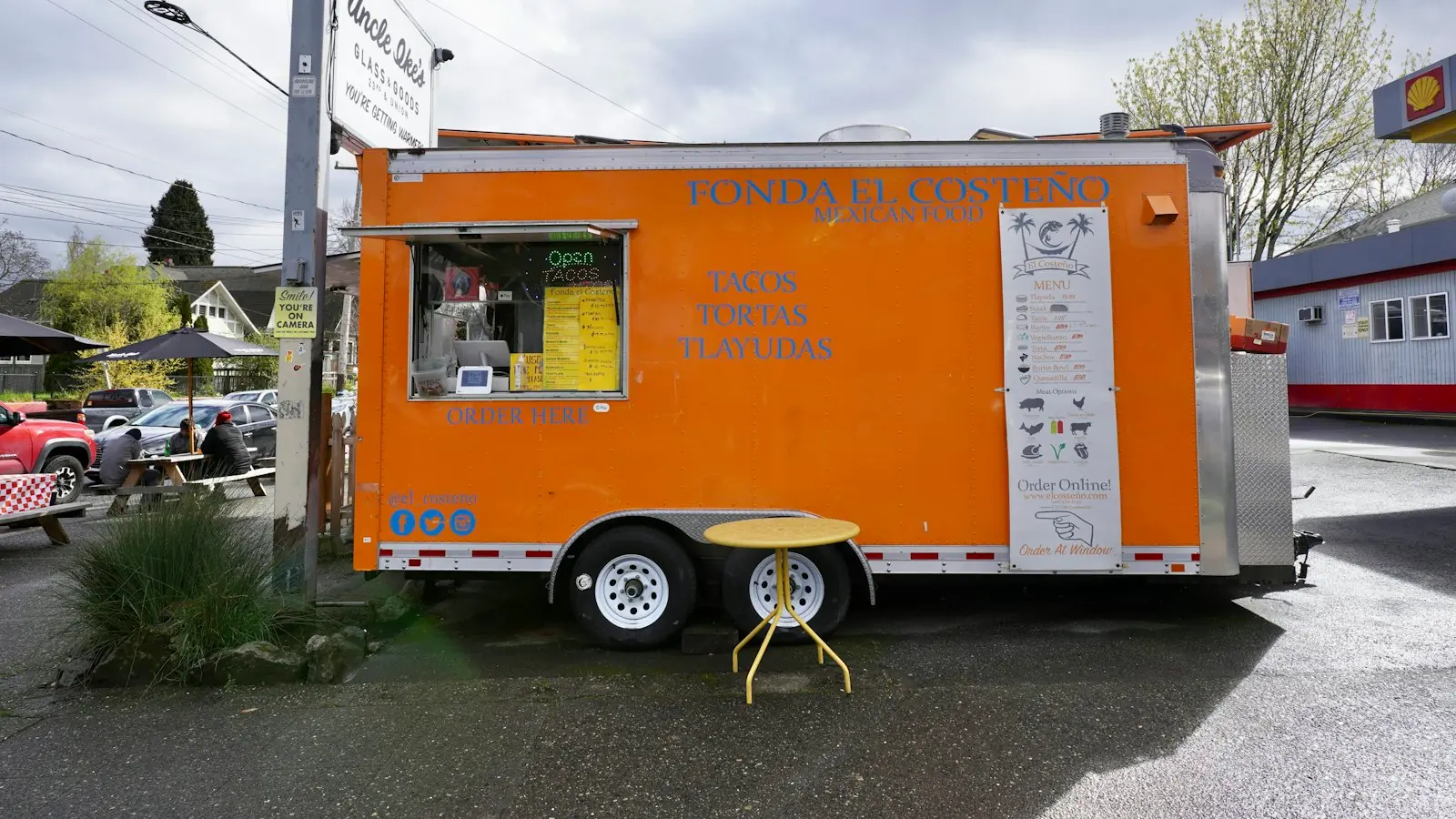
Quick answer: The clearest published number comes from The Hartford: on average, food cart owners paid about $232 a month, or $2,778 a year, for business insurance with the carrier. A full food truck usually costs more than that, because the truck itself needs commercial auto, and The Hartford's average for commercial auto across its customers is about $574 a month. Your real price depends on the truck's value, where and how far you drive, what you cook, your payroll, your claims history and the limits your events and permits demand. For general liability alone, NEXT reports that 66% of its food truck customers pay $21 to $33 a month.
This guide breaks the cost down policy by policy, shows what each published average does and does not tell you, and lists the levers that actually move a food truck premium. For what each policy covers, see our food truck and catering insurance guide.
Food truck insurance cost per month: the published averages
Few carriers publish food truck prices, and the figures you find online come from different pools of customers, coverage limits and years. The table below sticks to The Hartford's own published averages, each with what it is an average of. Treat them as reference points, not a quote.
| Coverage | The Hartford's published average | What it tells a food truck owner |
|---|---|---|
| Business insurance for food carts | About $232 a month, $2,778 a year, food cart owners | The closest published match. Carts are often smaller operations than a full truck, and the figure covers business insurance generally, not a specific bundle |
| Commercial auto | About $574 a month, $6,884 a year, all of its commercial auto customers | Averaged across every industry and fleet size. A single truck with a high-value kitchen build-out can land above or below it |
| General liability | $1,352 a year for restaurants; about $68 a month across all small business customers | Food service rates well above the small business average because of slips, burns and foodborne illness claims |
| Business owner's policy (BOP) | $413 a month for restaurants; about $141 a month across all small business customers | A BOP bundles liability with property. A restaurant's building and contents push that figure up, while a truck's gear is smaller |
| Workers' compensation | No flat average; priced per $100 of payroll | Scales with your payroll and job classification, so a solo owner and a three-truck crew pay very different amounts |
Do not add these rows together to get a total. Each average comes from a different group of customers, and a food truck does not buy every line on the list. A truck that buys commercial auto, general liability and equipment coverage, with no employees, prices nothing like a three-truck operation with a payroll and a liquor license.
What other published sources report
NEXT, a carrier we work with, and two other publishers report figures from their own food truck customers. They measure different things, so read each row on its own.
| Source | Coverage | Published figure | What it measures |
|---|---|---|---|
| NEXT | General liability | $21 to $33 a month | What 66% of its food truck customers pay (data updated October 2026) |
| NEXT | Workers' compensation | $86 a month | Median among its food truck customers (data updated October 2026) |
| Insureon | Business owner's policy | $96 a month | Its food truck customers, $1 million / $2 million limits (updated September 18, 2026) |
| Insureon | General liability | $37 a month | Its food truck customers, $1 million / $2 million limits |
| Insureon | Liquor liability | $64 a month | Its food truck customers |
| Insureon | Commercial auto | $209 a month | Its food service customers, including food trucks |
| Simply Business | General liability | $29 a month | Median among its food truck customers, policies bought July to December 2024 |
| Simply Business | Workers' compensation | $120 a month | Median among the same customers |
How we source these figures: each number links to its publisher and says what it measures. We look first to carriers we work with, then to regulators and industry bodies, then to other published cost studies. Every figure was checked on the publisher's page on November 5, 2026.
What each policy costs, and why
Commercial auto: usually the biggest line
For most trucks, commercial auto is the largest share of the bill, because it carries two exposures at once: liability for crashes on public roads, and physical damage to a vehicle that may be worth far more than its chassis once the kitchen is built in. The Hartford lists the factors that move commercial auto cost: the amount of coverage a specialized vehicle needs, limits and deductibles, the type of business and miles driven, driving records, and the number of vehicles.
Two food truck specifics matter. First, declare the full value of the build-out, not just the vehicle; an underdeclared truck saves a little premium and loses a lot at claim time. Second, if you tow a trailer kitchen, both the trailer and the tow vehicle belong on the schedule.
General liability: priced on sales and what you cook
General liability with products and completed operations coverage answers for customer injuries and foodborne illness. It is commonly rated on your sales, so a truck doing $400,000 a year pays more than one doing $90,000. Cooking method matters too: fryers and open flame read as higher risk than a cold-prep coffee or smoothie truck. The limits your events ask for set the floor, and $1 million per occurrence is a common organizer requirement.
Equipment, inventory and spoilage
Gear that travels needs coverage that travels, usually inland marine or an equipment floater, and spoilage is often a separate endorsement. The price follows the values you schedule: generators, fryers, refrigeration, POS hardware and stock on hand. Our inland marine guide explains why a fixed-address property policy is a poor fit for a truck.
Workers' compensation: the payroll formula
Workers' comp has a published formula. The Hartford explains that premium is the classification rate times your experience modification times payroll divided by 100. As an illustration only, with made-up numbers: a truck with $120,000 of payroll in a class rated at $2.00 per $100, with no experience mod yet, would start around $2,400 a year, or $200 a month, before fees and minimum premiums. Your actual rate depends on your state and classification.
Whether you must buy it is set state by state. California requires workers' compensation even if you have only one employee, while Texas is the outlier where most private employers can choose not to carry it. Our restaurant workers' comp page covers how food service classes are rated, and the EMR calculator shows what your experience mod does to the bill.
Liquor liability, if you serve alcohol
A truck that serves beer or cocktails at events needs liquor liability, because standard general liability excludes liquor claims for businesses in the business of serving alcohol. It is usually rated on alcohol sales. Our liquor liability guide covers dram shop law in the 16 states where Aiden Risk is licensed.
What drives your food truck insurance quote
The Hartford names type of assets, location, revenue, number of employees and claims history as factors in food cart pricing. For a truck, here is how those factors show up, and what underwriters will ask for.
| Driver | Why it moves the price | What to have ready |
|---|---|---|
| Truck value and build-out | Physical damage premium follows the declared value of the vehicle plus its kitchen | Purchase price, build-out invoices and photos |
| Where and how far you drive | Dense cities and long event circuits raise auto and liability exposure | Home base, usual service areas and annual mileage |
| Drivers | Violations and accidents on any listed driver raise auto rates | Names, license numbers and years of experience for everyone who drives |
| Sales | General liability and liquor liability are commonly rated on revenue | Last year's sales and a realistic projection |
| Cooking method | Fryers, grills, propane and generators raise fire risk | Equipment list and fire suppression details |
| Payroll and staff | Workers' comp is rated per $100 of payroll by class | Payroll by role and state |
| Claims history | Recent losses carry into pricing for several years | Three to five years of loss runs |
| Limits and endorsements | Higher limits, umbrellas and per-event additional insured requests add cost | Your event, commissary and permit insurance requirements |
Permit and event requirements that set your minimums
Your price is partly decided by people other than your insurer. City permits, commissaries and event organizers set limit floors and wording, and the gap between them can be wide. Chicago's mobile food license, for example, calls for a certificate with limits of at least $350,000, while many private festivals ask for $1 million per occurrence and additional insured status. Our food truck insurance guide compares permit rules in several cities.
Buy to the highest requirement you expect in a season, not the lowest. Raising a limit mid-season for one event is slower and often costs more than setting it right at renewal. A blanket additional insured endorsement can also save the cost and delay of endorsing every organizer one by one; see our additional insured guide for the wording to check.
How to lower food truck insurance cost without cutting the wrong corner
- Insure the truck commercially from day one. A personal auto policy is generally not built for business use, and a denied claim costs far more than the premium difference.
- Choose deductibles you can actually pay. A higher physical damage deductible lowers premium, as long as the cash is there when you need it.
- Keep driver records clean and the driver list short. Every listed driver is rated.
- Document fire safety. Suppression systems, extinguisher inspections and propane handling are what underwriters look for on a cooking truck.
- Report payroll and sales accurately. Guessing low only moves the cost to the audit, often with a bill attached.
- Bundle where you qualify. A BOP that combines liability and property can cost less than buying lines separately, if your operation is eligible.
- Track your certificates. Missing an event's wording leads to rush endorsements and lost bookings. Our certificate of insurance guide explains what organizers check.
On paying monthly: many carriers offer installment plans, and some add a small installment fee that paying in full avoids. Ask for both options when you compare quotes.
How Aiden Risk Solves Each of These Problems
Most food truck cost surprises come from buying in pieces. Aiden Risk is an AI-native independent commercial insurance broker that pairs an AI risk engine built for commercial insurance, which analyzes 140+ signals about a business, with a licensed broker on every account.
| The problem | How Aiden Risk solves it |
|---|---|
| No reliable price to plan around | Your licensed broker shops the program across carriers, so you compare real quotes for your truck instead of national averages. |
| Truck and build-out declared at the wrong value | A coverage gap analysis before binding checks the stated value against your purchase and build-out costs. |
| Paying for limits you do not need, or missing ones you do | Your broker sets limits from your actual permit, commissary and event requirements. |
| Workers' comp priced on the wrong class or payroll | Your broker reviews classifications and payroll by role before the policy binds, so the audit holds fewer surprises. |
| Event certificates that miss the organizer's wording | Your broker reviews requirements and issues certificates that match them, and the AI monitors your policies for changes between renewals. |
| Premium creeping up at renewal | The AI tracks your claims, drivers and policy changes through the year, and your broker remarkets the program when the numbers justify it. |
Aiden Risk charges no fee to work with it, with no platform fee or subscription; it is paid through standard carrier commissions. We place coverage across 100+ carriers and 13 commercial lines; our restaurant insurance page covers how we approach food businesses. Intake takes 5 minutes, and most straightforward businesses are placed in as little as 48 hours. We are licensed in 16 states, listed on our licenses page.
Key Takeaways
- The Hartford reports food cart owners paid about $232 a month, or $2,778 a year, for business insurance; a full truck usually costs more because of commercial auto.
- Commercial auto is typically the largest line, driven by the truck's value, build-out, drivers and mileage.
- General liability is rated on sales and cooking method, and event requirements set the limits floor.
- Workers' comp is priced per $100 of payroll by class, and the requirement to carry it varies by state.
- Published averages come from different customer pools, so compare real quotes rather than adding them up.
FAQs
How much is food truck insurance per month?
The Hartford reports that food cart owners paid about $232 a month on average for business insurance. A food truck usually pays more because it also needs commercial auto, which averages about $574 a month across The Hartford's commercial auto customers. Your price depends on the truck's value, location, sales, payroll, claims history and required limits. For general liability alone, NEXT reports that 66% of its food truck customers pay $21 to $33 a month.
How much does food truck insurance cost per year?
The Hartford's food cart average is about $2,778 a year for business insurance. A truck with commercial auto, general liability and equipment coverage will usually cost more, and adding staff, liquor service or higher limits raises it further.
What type of insurance does a food truck need?
Most trucks need commercial auto, general liability with products coverage, coverage for equipment and inventory, workers' compensation if you have employees and your state requires it, and liquor liability if you serve alcohol. Our food truck insurance guide covers each one.
Can I use personal auto insurance for a food truck?
Generally no. Personal auto policies are built for personal driving, and a truck used to run a business needs commercial auto. A claim on a personal policy for business use risks being denied.
How much general liability insurance does a food truck need?
Check your permits and event contracts first. City minimums can be lower than private organizers' requirements: Chicago's mobile food license calls for at least $350,000, while many festivals ask for $1 million per occurrence. Buy to the highest requirement you expect in a season.
Do food trucks need workers' comp?
If you have employees, usually yes, depending on the state. California requires it even with one employee, while Texas lets most private employers choose. Premium is calculated per $100 of payroll by job class.
How can I lower my food truck insurance cost?
Pick deductibles you can afford, keep driver records clean, document fire suppression and propane safety, report payroll and sales accurately, bundle into a BOP if you qualify, and set limits once at renewal to match your highest event requirement.
Starting a truck, adding a second one or lining up next season's events? Start with our restaurant insurance page: a 5-minute intake, a licensed broker on your account, and auto, liability, equipment and workers' comp matched to how your truck operates.